
Charleston County City Directory Collections
Charleston County Public Library's directory holdings make the county unusual: the run begins with a 1735 abstract and has large later sequences in several formats. A directory is a time-stamped listing, not a modern resident roll. Its best use is to establish that a name, business, or address appeared in a particular edition, then move to another record when a question calls for proof of ownership, a family relationship, or a later event. CCPL places early material, microfilm, original books, and licensed database access in the South Carolina Room rather than treating them as one continuous online file.
| Charleston collection | Years represented | Where held | Access route |
|---|---|---|---|
| Abstract books and microfiche | 1735 and selected years, 1782-1860 | CCPL South Carolina Room | Local historical collection |
| Digitized / HeritageQuest run | 1830, 1859, 1866-67, 1869, 1872-1925, 1927-32, 1934 | CCPL databases | Terms vary by account and location |
| Microfilm volumes | 1866-1932, with listed gaps | CCPL | Inspect volume and front matter |
| Original books and R.L. Polk volumes | 1934-present, except listed missing years | CCPL catalogue / South Carolina Room | Book or microform access |
The catalogued R.L. Polk sequence has real interruptions, including 1949, 1952, 1954, 1956-57, and 1962-67. A missing name in one of those years is not a negative result because there was no Polk publication to search. Note: Keep the volume year and format with every transcription so another researcher can retrace the result.
Charleston County City Directories, 1735 Onward
Charleston County's records have changed media many times. The early directory material is often an abstract or microfiche. Later editions appear on microfilm and in original books. Selected middle-period years are available through a library database, while the Charleston Library Society and Lowcountry Digital Library provide another channel for digitized directories, manuscripts, and local archival material. That long sequence is a records story worth preserving: it lets a present-day family question move from a printed name to maps, deeds, census schedules, and probate material without pretending that any one listing settles the question.
The CCPL city-directory collection illustrates the directory formats and historical use notes.
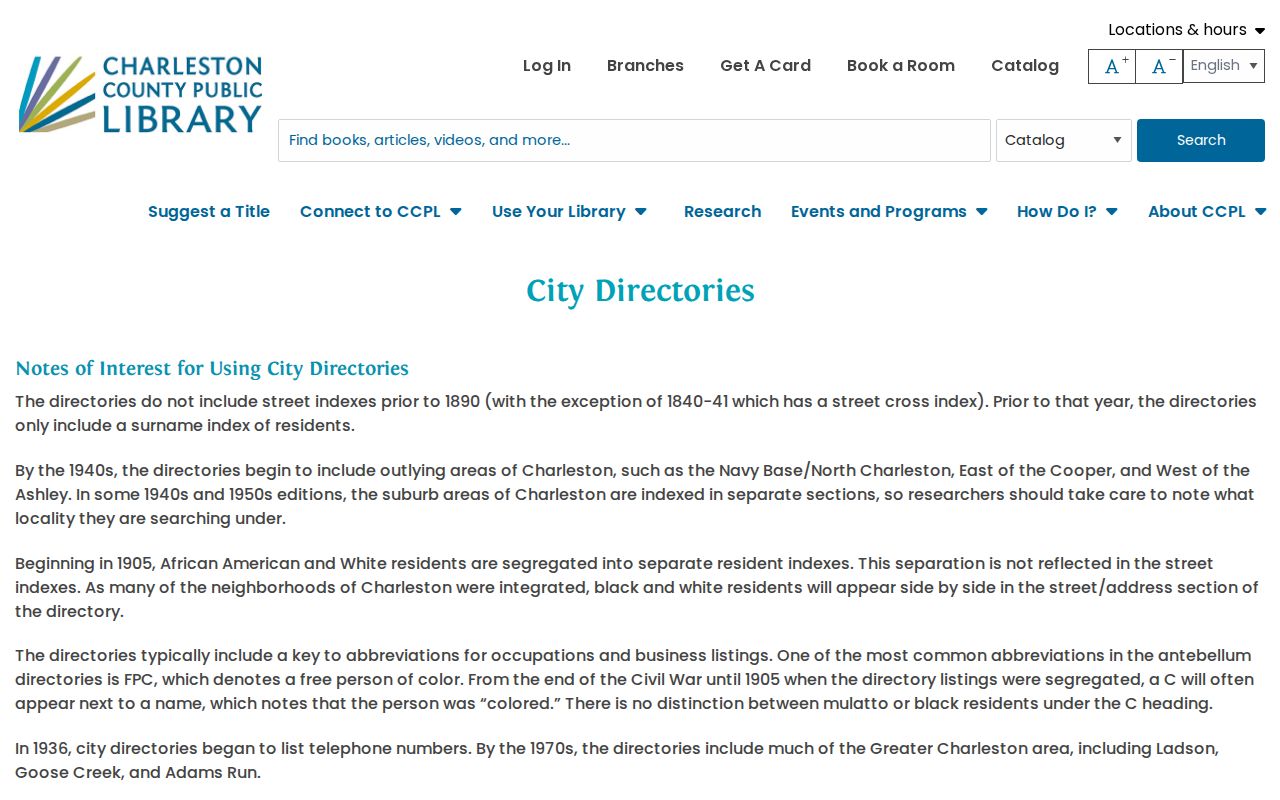
The collection view is a useful reminder to start with the edition nearest the known date, then check the volume before and after it rather than skipping across decades.
- 1735 and the late eighteenth century: CCPL identifies early abstracts and microfiche among the first directory evidence.
- 1866 through the early twentieth century: microfilm and selected digitized years expand the searchable run.
- 1934 onward: original books and the Polk sequence carry the record forward, with the catalogue gaps noted above.
Charleston County City Directory Gaps
Year gaps are only one reason a search can fail. CCPL says ordinary street indexes generally begin in 1890, with an important 1840-41 exception. Before then, a surname or business listing may be the practical entry point. In the 1940s and 1950s, Navy Base/North Charleston, East of the Cooper, and West of the Ashley can appear in separate locality sections. By the 1970s, directories cover much of Greater Charleston, including Ladson, Goose Creek, and Adams Run. A central-Charleston heading is therefore not always where a county resident was filed.
Search the edition's locality labels, its index, and the spelling used in that year. Charleston County includes city and county geographies that do not always line up with a familiar mailing name. The South Carolina Room holds maps, clippings, microforms, and historical city records that help identify the period's ward, cross streets, or locality. Its South Carolina history service also provides genealogy assistance by appointment.
CCPL's South Carolina Room and Charleston Archive provide the local-history access point for these materials.
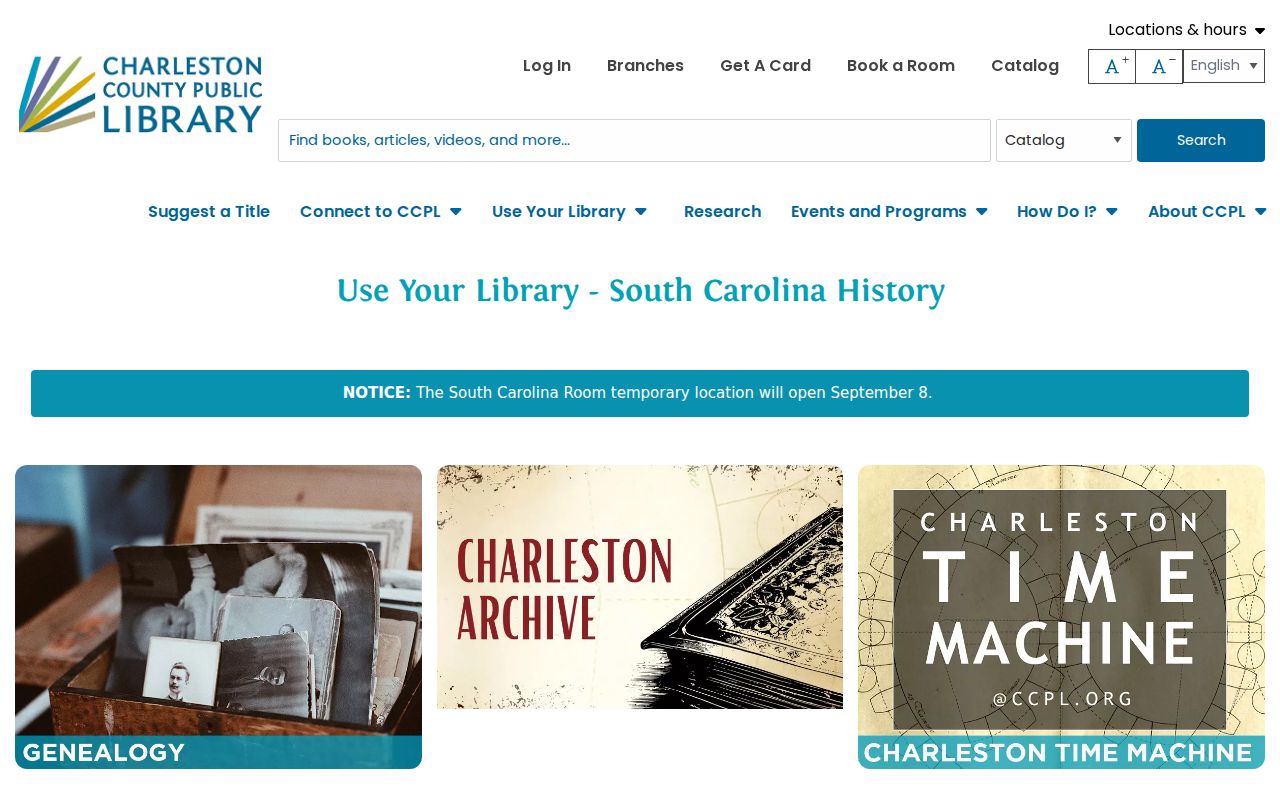
Using the room's books, maps, and database access together can turn a failed name search into a better documented locality search.
Reading a Charleston County City Directory
A Charleston County city directory entry is compact, so exact transcription matters. The alphabetical resident portion commonly supplies a surname, given name or initials, an address, and a shortened occupation or place-of-business clue. Later volumes may add relationship or widow-style notation. Business listings are a separate layer and can be valuable when a person appears under a firm name. Check the abbreviation key printed in that particular edition before expanding an abbreviation, because the key, coverage, and structure can change from volume to volume.
| Name form | Surname, given name, and initials as printed. Preserve the spelling before searching variants. |
|---|---|
| Address | A residence or business location for that publication year, not proof of a move date. |
| Occupation clue | A frequent abbreviated occupation or place-of-business reference. |
| Relationship notation | Later editions may use spouse or widow-style notation. Confirm the volume's key. |
| Street entry | Address-order listing only when that edition includes a street section. |
- Criss-cross directory
- The street-order part of a directory, when present, used to locate a numbered address and nearby printed entries.
- Alphabetical resident entry
- The name-order listing that supplies the form of a person's name and the details printed beside it.
- Abbreviation key
- The explanatory key inside a volume. Read it before turning a short mark into a family or work conclusion.
Charleston County City Directory Conventions
Some historical Charleston County volumes reflect the social classifications of their own era. CCPL notes that antebellum volumes may use FPC for free person of color. From the end of the Civil War until 1905, a C can appear beside a name, and from 1905 the resident indexes are separated while the street indexes are not. These are source-created conventions, not labels to apply to people now. A careful transcription records the printed notation, identifies the volume and section, and uses nearby street entries or the nearest released census to understand the source context.
This indexing history also changes search tactics. If a surname is missing in one resident index, check the relevant street section where available and look for spelling variants or a different locality heading. The 1868 Charleston County Voter Registration Roll at CCPL is another dated historical source that can support family-history work, but it is not a substitute for a current voter record. Note: A directory entry is strongest when the source's own period conventions are preserved and explained.
Charleston County City Directory Research Rooms
CCPL's South Carolina Room is more than a directory shelf. It serves as the reading room for the Charleston Archive and holds books, microforms, maps, clipping files, deeds and probate research material, plus licensed genealogy databases. The library identifies directories from 1782, marriage microfilm from 1879-1922, and indexes to Charleston County wills and miscellaneous records from 1671-1868. The historic-property research guide is particularly useful when a directory address needs to be connected to land, maps, or a recorder reference.
Charleston Library Society's Digital Library works with Lowcountry Digital Library to provide public access to digitized directory volumes alongside manuscripts and archival documents.
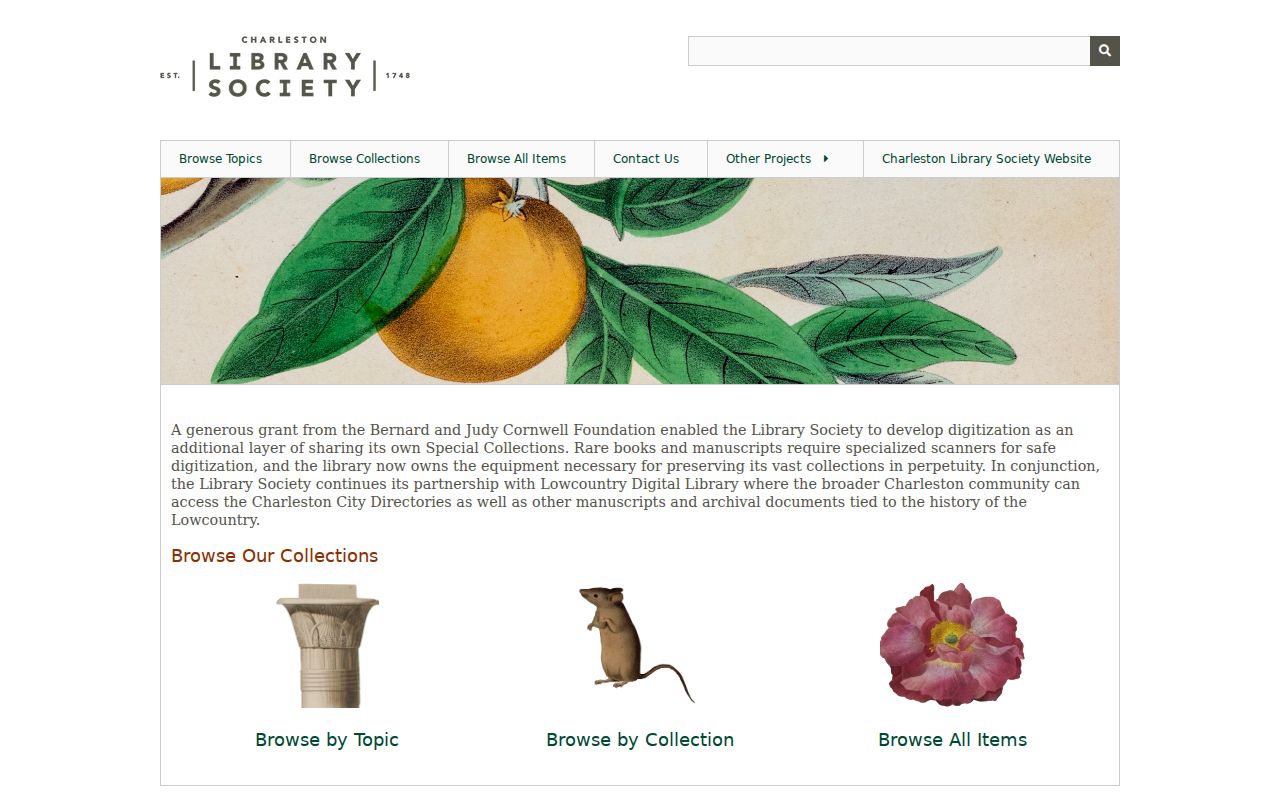
The digital collection is a companion to CCPL, not a promise that every directory or document can be read online under the same access terms.
Charleston County Directory Census Pairing
Directory evidence works especially well in the years between federal censuses. For Charleston County, start with the edition closest to the family date, then compare the nearest released census rather than treating either source as a complete answer. The full federal population census is released on a 72-year schedule, and 1950 is the newest available in 2026. CCPL describes HeritageQuest as a source for American census records and local-history material, while its other licensed databases may offer different access. Census districts and wards reflect their own date, so they should not be converted casually into a modern ZIP code or municipal boundary.
A surname, address, and occupation clue can connect the two sources. Census material can add household composition, age, birthplace, and a district context that may not appear in the printed volume. Differences are useful research prompts: an absent person may have moved, used a different name form, appeared in another locality section, or been omitted. Test those possibilities with a later directory, a deed, a probate file, or an obituary rather than selecting the most convenient explanation.
Charleston's growth also makes the comparison more precise. A directory may file a person under a Navy Base, North Charleston, East of the Cooper, or West of the Ashley section, while a census uses the district and boundary arrangement of its own date. Record both labels. The older wording can explain why a name appears to vanish from an expected heading even though the household remained in the wider county area.
Tracing Charleston County City Directory Families
For family history, begin with the closest known year and capture every printed detail: name form, initials, address, occupation clue, business clue, locality heading, and the volume's page or image reference. Move forward and backward one available edition at a time. A change can suggest a move, a new business, a death, an omission, or simply a shift to a separate suburb section. Pair each directory year with the nearest released federal census, which is available through 1950 under the federal 72-year schedule, then use the county's land and probate records to test a relationship or title question.
- Find the earliest available listing for the person or address and transcribe it exactly.
- Check the next available edition in each direction, recording address, name, and locality changes.
- Use the street section when the volume has one to compare the address with nearby listed entries.
- Compare the nearest released census for household composition, age, birthplace, occupation, and ward or district context.
- Use a deed, probate file, death index, or obituary collection to test why a person later disappears.
For the backward trail of one address after a directory clue is found, the Charleston County previous residents material follows the deed and parcel record rather than repeating the historical shelf. A disappearance should remain a question until another dated record supports an answer.